The Meaning of the Fruit of the Spirit
Galatians 5:22 to 23 names nine qualities that many people learn early and spend a lifetime considering: love, joy, peace, longsuffering, gentleness, goodness, faith, meekness, and temperance. The passage calls them the fruit of the Spirit, using the singular word fruit to suggest a unified life rather than a set of separate achievements. Its familiar list is not a personality test or a polished ideal. It is part of Paul's larger reflection on the kind of character that grows when life is shaped by the Spirit.
What are the nine fruit of the Spirit?
The King James Version reads, "But the fruit of the Spirit is love, joy, peace, longsuffering, gentleness, goodness, faith, Meekness, temperance." Love is the outward seeking of another's good. Joy is a deep gladness not limited to favorable circumstances. Peace speaks to wholeness and reconciliation. Longsuffering is patient endurance with people and difficulty. Gentleness joins strength to tenderness, while goodness turns integrity toward action. Faith can carry the sense of faithfulness or trustworthiness. Meekness is humility with restraint, not weakness. Temperance is self control, the ability to direct desire rather than be ruled by it. These qualities are often memorized as nine separate words, but Paul's singular "fruit" still matters. He is describing a life made whole by the Spirit, where each quality gives shape and balance to the others.
What is the contrast with the works of the flesh?
Paul places the fruit of the Spirit after a sober list of "the works of the flesh" in Galatians 5:19 to 21. The contrast is deliberate. The works he names fracture relationship through rivalry, envy, anger, and self serving desire. Fruit, by contrast, grows. It is organic language for a changed pattern of life, not a scorecard for moral performance. Galatians 5 also speaks of freedom, but it does not define freedom as simply following every impulse. Freedom becomes the capacity to serve one another in love. This context keeps the nine qualities from becoming decorative virtues. They answer real pressures in a community where people can wound one another. Peace matters because conflict is real. Gentleness matters because power can be misused. Temperance matters because desires can govern us. The passage is hopeful because growth is possible, yet it remains honest about what that growth must resist.
How can the fruit of the Spirit shape everyday life?
The nine qualities are most useful when brought close to ordinary moments rather than reserved for an abstract ideal. Longsuffering may appear in the pause before answering a sharp question. Gentleness may shape the way a correction is offered. Peace may mean making room for a difficult conversation instead of avoiding it. Temperance can guide a decision about time, speech, money, or appetite. These are not always dramatic actions, and that is part of the passage's wisdom. Fruit grows over time, often quietly and with attention. A helpful practice is to choose one quality for a week and notice where it is already present, where it is needed, and what might support it. The purpose is not self criticism. It is to become more receptive to the Spirit's work in real relationships. The list can offer a gentle vocabulary for reflection without turning every day into a test of spiritual achievement.
Why do the nine fruit work well as a hallway gallery wall?
A hallway is a place of passing, gathering, and beginning again, which makes it a natural setting for words meant to accompany everyday life. Nine small botanical prints can give each quality a distinct visual presence while allowing the collection to read as one whole. A person may notice patience while leaving for work, joy while carrying laundry, or peace during an unsettled evening. The value lies in repetition without pressure. Unlike a long passage that requires a settled reading time, a gallery wall can offer one clear word at a glance. Botanical imagery also fits the metaphor closely. Leaves, stems, and fruit suggest that character is cultivated, seasonal, and living. In a fruit of the Spirit collection, the arrangement can be decorative, but its deeper role is attentiveness. It keeps a language of love and faithfulness within the ordinary pathways of a home.
Frequently asked questions
What are the nine fruit of the Spirit in Galatians 5?
They are love, joy, peace, longsuffering, gentleness, goodness, faith, meekness, and temperance. Many modern lists use patience for longsuffering and self control for temperance, while the King James Version preserves the older words. The passage concludes by saying there is no law against such qualities.
Why is fruit singular in Galatians 5:22?
Paul uses the singular word fruit, which suggests that these qualities belong together as the result of life shaped by the Spirit. They are not meant to be isolated achievements or a list of traits someone must perfect independently over time.
How can I teach the fruit of the Spirit at home?
Choose one quality at a time and connect it to ordinary family moments, such as sharing, waiting, apologizing, or encouraging someone. Simple questions about what love, patience, or gentleness could look like that day keep the passage practical and approachable. A visible reminder can help children return to those questions.
Bring it to your wall

Fruit of Spirit Set 9 Bible Verse Wall Art Aesthetic Christian Botanical Prints Galatians 5 22 Modern Gallery Wall Kitchen Decor

Love Fruit of the Spirit Wall Art, Galatians 5:22-23 Botanical Bible Verse, Christian Home Decor Gift
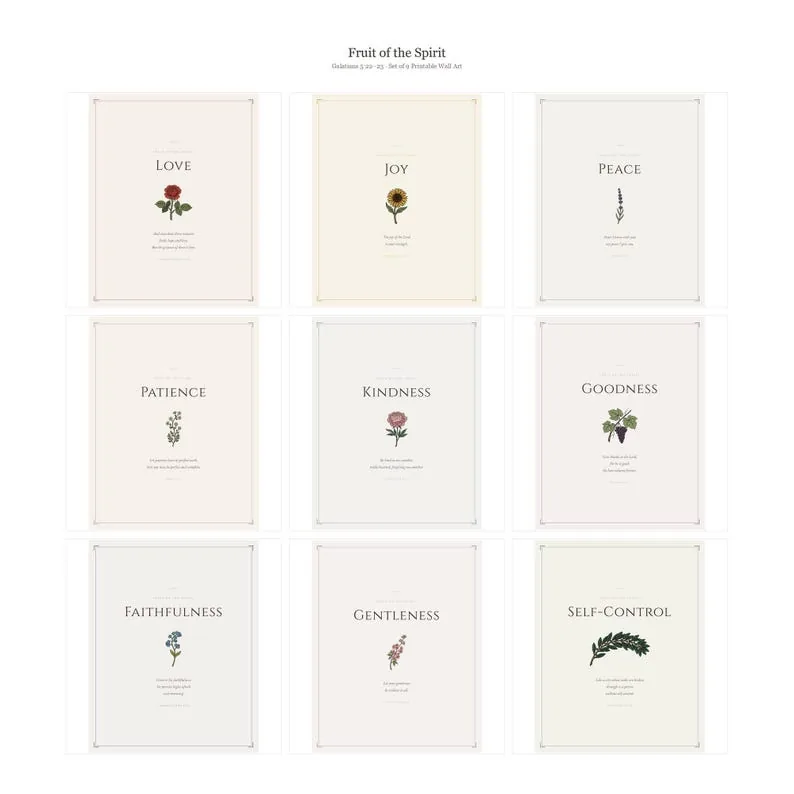
Fruit of the Spirit Vintage Wall Art Set of 9 Farmhouse Scripture Prints Galatians 5 22 Kitchen Decor