The Stories Behind Four Beloved Christmas Hymns
Silent Night, O Holy Night, Away in a Manger, and Joy to the World sound inseparable from Christmas, but they did not emerge from one place or moment. Their stories cross Austria, France, England, and the United States, and they include both well documented collaborations and unresolved questions of authorship. Knowing that history does not reduce the hymns to dates and names. It reveals how poems, melodies, translations, and congregational use gradually became a shared Christmas tradition.
Who wrote Silent Night, and when was it first performed?
Joseph Mohr wrote the German text of Silent Night, and Franz Xaver Gruber composed its melody for a Christmas Eve performance in 1818. The hymn was first heard at St. Nicholas Church in Oberndorf, near Salzburg, Austria. Mohr, a Catholic priest, had written the poem before asking Gruber, a teacher and church musician, to provide music. The original title was "Stille Nacht, heilige Nacht." Its gentle character came from the close partnership of words and a singable melody, not from the later legends that accumulated around the occasion. Stories often claim that a broken organ forced the use of a guitar, but the precise reason for the original accompaniment is not securely established. What is certain is the authorship, the place, and the 1818 performance. Traveling singing families later helped carry the song beyond the region, and English translations made it familiar to a much wider audience.
How did O Holy Night begin in France?
O Holy Night began as a French Christmas poem by Placide Cappeau, set to music by composer Adolphe Adam in 1847. Its French title is commonly given as "Minuit, chrétiens," and the song is also known as "Cantique de Noël." Cappeau's text reflects on the Nativity and the spiritual significance of redemption, while Adam's expansive melody gives the words a dramatic shape suited to a solo voice as well as congregational listening. The English hymn familiar today is a translation and adaptation, so its wording should not be treated as a line for line reproduction of the French original. Over time, the song gathered stories about controversy and public reception that are sometimes repeated without careful evidence. The firm historical center is the collaboration between Cappeau and Adam and the 1847 composition. Its continued place at Christmas rests on how the music moves from stillness and expectancy toward a broad declaration of hope.
Did Martin Luther write Away in a Manger?
Martin Luther did not write Away in a Manger, despite an early American tradition that presented it as his cradle hymn. Modern hymn scholarship treats that attribution as disproved, and the author of the first two stanzas remains unknown. The carol appeared in the United States during the nineteenth century and circulated through published collections before becoming attached to several melodies. A third stanza was added separately, another reason not to call the hymn the work of one known writer. Its language creates a quiet devotional picture of the infant Jesus, drawing especially on Luke 2:7 and the child laid in a manger. Some phrases reflect later imagination rather than details stated directly in the Gospel. That distinction helps readers appreciate the hymn without confusing it with the biblical text. Its history is best told as an anonymous carol shaped by publication, adaptation, and use, not as a lost composition by Luther.
Why did Isaac Watts write Joy to the World?
Isaac Watts published Joy to the World in 1719 as a Christian interpretation of Psalm 98, not as a narrative retelling of Jesus' birth in Bethlehem. Psalm 98:4 says in the KJV, "Make a joyful noise unto the LORD, all the earth: make a loud noise, and rejoice, and sing praise." Watts reshaped the psalm's worldwide call to praise around the reign of Christ, extending the theme to creation, righteousness, and blessing. This explains why the hymn speaks of the Lord coming and the earth receiving its king without mentioning shepherds, angels, or a manger. The familiar tune became associated with the text later, and its exact musical lineage has been described in different ways, so it is safer not to reduce it to a simple claim of authorship by Handel. The hymn became a Christmas standard because its language of arrival and universal joy fits the season, even though Watts's original subject is broader than the Nativity alone.
Frequently asked questions
What are the origins of Silent Night?
Joseph Mohr wrote the German poem, and Franz Xaver Gruber composed the melody. It was first performed on Christmas Eve in 1818 at St. Nicholas Church in Oberndorf, Austria. Later singers and translators helped it travel beyond the Salzburg region and become one of the best known Christmas hymns.
Who wrote O Holy Night?
Placide Cappeau wrote the French poem, and Adolphe Adam composed the music in 1847. The English words widely sung today came through later translation and adaptation, so they differ from a literal rendering of the original French text while preserving its Nativity theme.
Was Away in a Manger written by Martin Luther?
No. The traditional attribution to Martin Luther has been disproved. The author of the first two stanzas is unknown, and the hymn emerged through nineteenth century American publication and use. A later third stanza and multiple melodies also reflect its gradual development.
Is Joy to the World based on a Bible passage?
Yes. Isaac Watts published it in 1719 as a Christian interpretation of Psalm 98. It celebrates the Lord's reign and calls the whole earth to joy. It does not retell the manger scene, but its themes of the coming king and creation's praise led it to become closely associated with Christmas.
Bring it to your wall
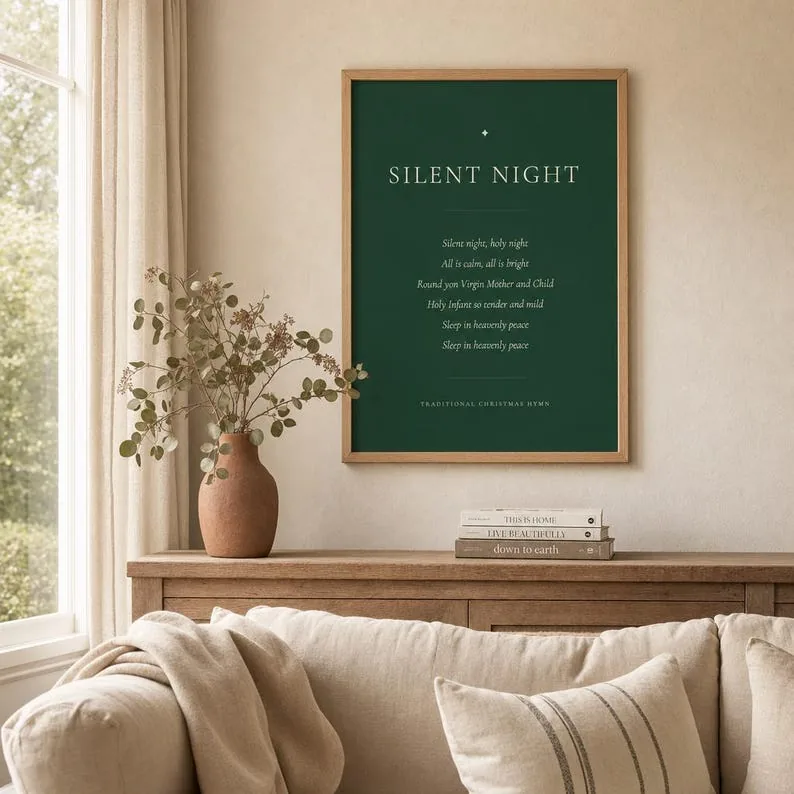
Silent Night Christmas Print, Traditional Hymn Wall Art, Minimalist Christian Christmas Decor, Holiday Scripture Printable
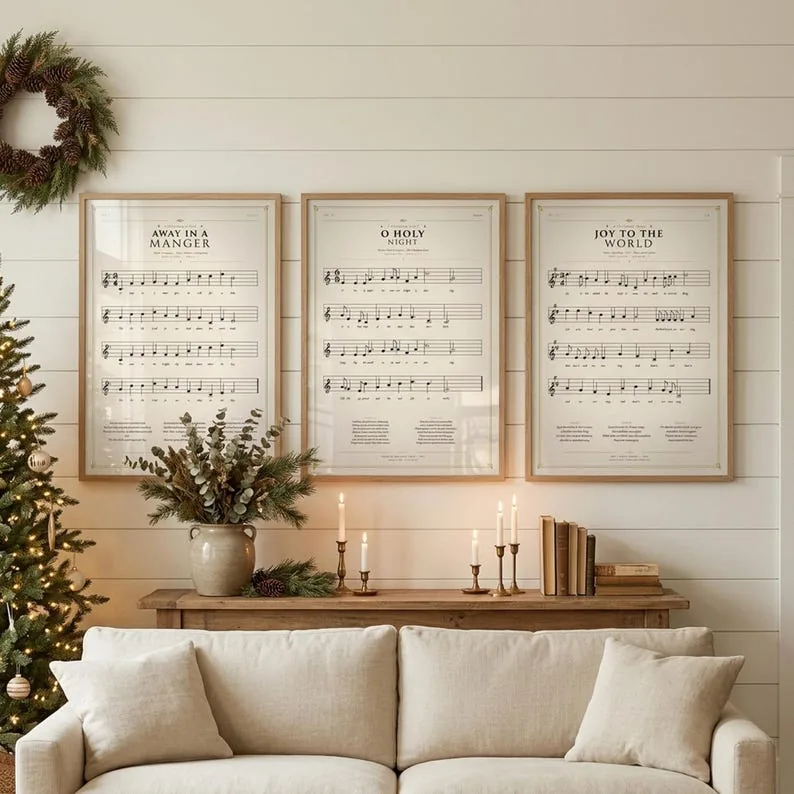
Christmas Hymn Print Set of 3: Away in a Manger, O Holy Night, Joy to the World, Vintage Christian Hymn Sheet Music Gallery Wall
Joy to the World Print, Psalm 98:4 Vintage Christmas Hymn Sheet Music Wall Art, Christian Hymnal Page Holiday Decor